
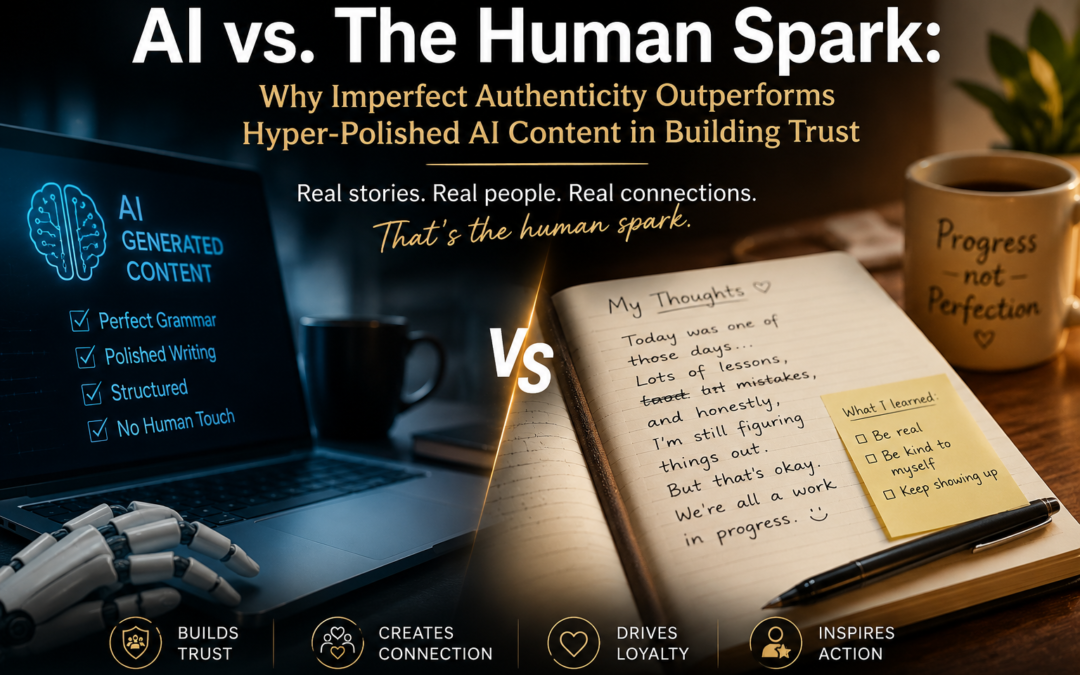
AI vs. Human Authenticity: 5 Reasons Why Real Content Builds Trust
“In a world where almost everyone can create polished content with AI, authenticity has become the rarest—and most valuable—currency.15 Powerful Reasons Why SINA Daily Diaries Will Become Your Daily Source of Inspiration, Knowledge, and Social Impact
“In a world where almost everyone can create polished content with AI, authenticity has become the rarest—and most valuable—currency. “Artificial Intelligence has transformed the way we create content. With a few prompts, anyone can generate flawless blog posts, polished social media captions, professional emails, and even compelling marketing campaigns.
Grammar is impeccable. Formatting is clean. Every sentence flows.
Yet something unexpected is happening.
Despite the rise of sophisticated AI-generated content, audiences are increasingly gravitating toward creators who sound… human.
The posts with a typo.
The videos with an awkward pause.
The voice note recorded in a noisy room.
The LinkedIn story written from genuine experience rather than algorithmic perfection.
Ironically, what AI is helping us eliminate is exactly what many audiences are beginning to value most: authenticity.
AI vs Human Authenticity :The Trust Gap
People don’t merely consume content—they evaluate the person behind it.
Every time someone reads a post or watches a video, they’re asking questions such as:
- Is this person genuine?
- Can I trust them?
- Have they actually experienced what they’re talking about?
- Does this sound real?
When every piece of content begins to resemble every other piece—perfect punctuation, flawless structure, predictable hooks—the emotional connection weakens.
Readers may admire polished content.
But they remember authentic people.
AI vs Human Authenticity: Why Imperfection Feels More Human
Human communication has always been imperfect.
We hesitate.
We repeat ourselves.
We occasionally misspell words.
We laugh unexpectedly.
We change our minds halfway through a sentence.
These aren’t flaws.
They’re signals of humanity.
When audiences notice these natural imperfections, they often subconsciously recognize that there is a real person on the other side of the screen.
That recognition builds trust.
AI Has Raised the Standard—Not Replaced Authenticity
There’s no denying AI’s value.
It helps us brainstorm faster.
It improves grammar.
It saves hours of editing.
It allows creators to focus on bigger ideas rather than repetitive tasks.
But AI works best as an assistant—not as a replacement for personal voice.
The strongest creators today don’t simply publish AI-generated content.
They inject:
- personal stories
- lived experiences
- opinions
- emotions
- humor
- lessons learned from failure
These are things no language model can genuinely experience.
AI vs Human Authenticity: Audiences Crave Stories, Not Perfection
Think about the content you’ve shared with friends recently.
Was it perfectly written?
Probably not.
More likely, it was something that made you laugh, think, or feel understood.
Maybe someone admitted they failed.
Maybe they shared an embarrassing moment.
Maybe they openly discussed a business mistake.
Those moments resonate because they remind us that success isn’t built by perfect people.
It’s built by real people.
AI vs Human Authenticity: The Rise of “Messy Marketing”
Brands are beginning to realize that authenticity often outperforms perfection.
Instead of highly produced commercials, many now share:
- behind-the-scenes footage
- unedited customer testimonials
- founders speaking directly into their phones
- spontaneous office conversations
- raw product development updates
These feel believable.
Consumers increasingly associate polished advertising with sales.
They associate genuine storytelling with honesty.
AI Can Write. Humans Create Meaning.
Artificial Intelligence can arrange words.
Humans provide context.
AI can summarize research.
Humans interpret life.
AI predicts likely responses.
Humans surprise people.
The difference isn’t intelligence.
It’s experience.
No AI has celebrated a promotion, struggled through a failed business, comforted a grieving friend, or overcome personal setbacks.
Those experiences shape the insights that make content unforgettable.
AI vs Human Authenticity :  Authenticity Doesn’t Mean Low Quality
Being authentic isn’t an excuse for carelessness.
There’s a difference between being real and being unprofessional.
Quality still matters.
Clear writing matters.
Good design matters.
Thoughtful editing matters.
The goal isn’t to intentionally make mistakes.
It’s to avoid editing away your personality.
Your audience doesn’t expect perfection.
They expect honesty.
AI vs Human Authenticity: The Future Belongs to Human-AI Collaboration
The most successful creators won’t choose between AI and authenticity.
They’ll combine both.
Imagine using AI to:
- organize your ideas
- improve readability
- generate headlines
- refine grammar
Then adding:
- your personal stories
- your opinions
- your humor
- your emotions
- your unique perspective
That’s where the magic happens.
AI increases efficiency.
Humans create connection.
AI vs Human Authenticity
As AI-generated content becomes increasingly common, audiences will naturally seek content that feels personal, relatable, and genuine. A perfectly written article may capture attention, but authentic stories, honest opinions, and lived experiences are what build lasting trust.
Creators who share their unique perspectives, lessons learned, and personal journeys will stand out in a digital landscape saturated with AI-generated material. Authenticity will no longer be optional—it will become a key competitive advantage.
AI Will Become a Creative Assistant, Not a Replacement
The future belongs to creators who embrace AI as a productivity tool rather than relying on it to replace their voice. AI can help with brainstorming ideas, organizing information, refining grammar, and improving readability. However, it cannot replicate human emotions, personal experiences, or the insights gained through real-life challenges.
The most successful content creators will use AI to enhance efficiency while ensuring that every piece of content reflects their personality, values, and expertise.
Trust Will Outweigh Perfection
Consumers are becoming more discerning about the content they engage with. They can often recognize when content feels overly polished, generic, or lacks genuine insight. In response, brands and creators are shifting toward more transparent and relatable communication.
As artificial intelligence becomes more accessible, perfectly polished content will become increasingly common.
What will become rare is genuine human perspective.
AI can generate information, but it cannot genuinely understand the emotions, relationships, and experiences that shape human creativity. Empathy, intuition, humor, cultural understanding, and storytelling remain uniquely human strengths.
These qualities enable creators to inspire, influence, and connect with audiences in ways that technology alone cannot achieve.
In the coming years, trust won’t belong to the creators who sound the most perfect.
It will belong to those who sound the most real.
Because audiences don’t follow flawless content.
They follow people.
And while AI can help us write faster, only humans can create the spark that turns readers into loyal communities.
The future of content isn’t AI versus humans. It’s AI powered by authentic human voices. In the trust economy, your imperfections aren’t liabilities—they’re proof that there’s a real person behind every word.https://www.youtube.com/shorts/1jk8Cw-cYtU